Rehabilitation Therapy

Our approach to therapy is truly state-of-the-art, and we provide the finest in therapists, equipment and services. Our therapy room is large and clean, well-lit and welcoming. We’ll design a therapy program that is tailored to get you up, around, and functioning at the highest level possible. It’s our goal to get you back in the swing of things, and we employ a variety of high-tech and (good old-fashioned) hands-on therapeutic approaches that we believe will work wonders for you!

In-House Therapy

Our Vision — Your Success

The therapy staff is part of the “bricks and mortar” of Woodland Health & Rehabilitation, and our therapists take pride in the performance of the therapy department as well as the entire facility.  We understand each patient has unique and special needs, so our in-house therapy program is completely customizable to meet them. This is a collaborative effort among our team members, who work with your physician to create a unique vision and treatment plan for you. We can even provide specialized equipment to aid in your treatment.

We have a full-time in-house therapy team – not outside contractors or agencies – so our patients get to know their therapists, and vice-versa. Having the same therapy team working with you every day is a big plus, and we always seek to achieve just the right “match” between patient and therapist, for optimal results and comfort.

Our Holistic Approach

Our therapists receive education and training to other disciplines, to ensure the continuity of care between therapy and nursing. At Woodland Health & Rehabilitation, we work together with one goal in mind: your comfort and health.

Physical Therapy
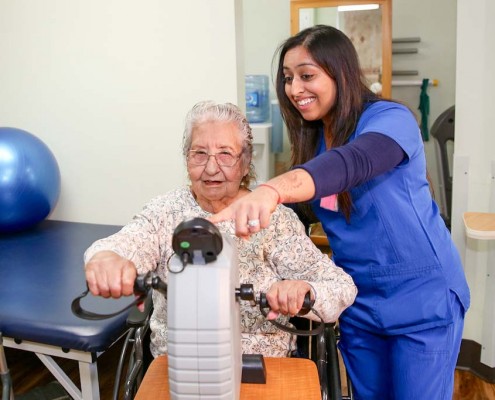
Physical Therapists with patients
Physical Therapist with woman

Rehab to Return Home

Anticipating Your Every Need

We work with each resident, their family and their healthcare provider to determine the best care and treatment plan. When the goal is to return home, we explore every detail about our resident’s prior living arrangements. Family members are encouraged to participate in the care so that they can help their loved one prepare for discharge. We frequently perform a “home assessment,” which we can use to develop a custom-designed rehab program that prepares our residents for any particular challenges they might experience once they get home.

When the plan is to stay in our facility once the therapy program is complete, we make sure that we work side-by-side with our nursing staff so that our residents can continue to function at their highest possible level to preserve their independence and participation. We continue to do ongoing screenings after completion of their program to make sure that our residents are maintaining their abilities at the best possible level.

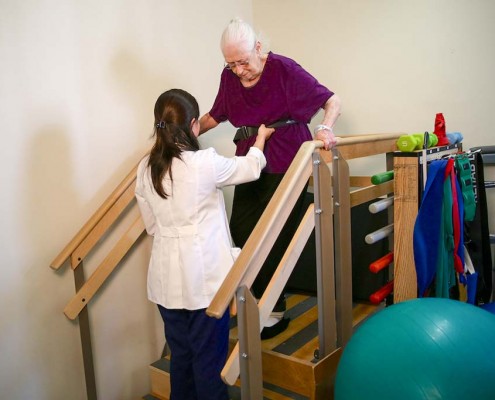
Physical Therapist works with woman on stairs

Your Rehab Team

Many Disciplines — One Goal


Once the resident is on the road to recovery, the rehab therapy team rolls into action. The team consists of physical therapists (PT), physical therapy assistants (PTA), occupational therapists (OT), certified occupational therapy assistants (COTA), a speech and language pathologist (SLP), and a rehab aide/technician, who work together based on the individual needs of each resident.

The Physical Therapist assesses and treats impairments in strength and function that occur as a result of injury, disease, age-related degeneration, or environmental factors. Physical therapy treatments are performed by the physical therapist, or a physical therapy assistant who treats under the direction of the supervising physical therapist.

The Occupational Therapist assesses the impact that a decline in function has in the residents’ ability to participate in their life by performing everyday tasks such as dressing and bathing, or being able to return to work or engage in previous hobbies. Occupational therapy treatments are performed by the OT (or a COTA working under the direction of the supervising OT).

The Speech Therapist and/or Language Pathologist assesses language, cognition, and swallowing dysfunction. A Speech Therapist’s main goal is helping residents with swallowing difficulties. They will work with residents that may have modified diets to help them get back to eating the types of foods they love.

These three disciplines work together along with nursing, social services, activities, the business office, families, caregivers, and local communities to assess functional potential, and collaborate on the unique goals for every resident. Family members are essential contributors to this interdisciplinary rehab team, as they provide the background and detail of their loved one’s life to incorporate into our plan of care.

While in our care, please know that your loved one will be well taken care of. Because all of our rehab therapists are in-house (rather than outside contractors), our relationships with our residents are superior. Our therapists and nurses work together as a team, and due to the continuity of their care, a strong trust is built with our residents. There is comfort in knowing that the same smiling face will be there to help them through their rehab each day.
On-Site Decision Makers

We Don’t Wait To Make Important Decisions

In order to provide the best care possible, our caregivers must be empowered to make decisions, because in many cases, every second counts. So rather than waiting for a decision from higher-ups who might not understand the crucial details of any given situation, we leave the decisions to those who are closest and know best: the caregivers, doctors, and nurses who work with our residents 24 hours a day, seven days a week.

It’s important to us that our residents, as well as their family members, feel loved, informed and comfortable during their stay at our facility. Quality of life is just as important as quality of care in a skilled nursing facility – and we work hard to make sure that every resident is as happy and comfortable as possible. Every staff member on the floor and in the office knows each resident by name. They make eye contact as they greet them, and once a request is met, they ask if there is anything else they may need. If there is a request, the team member is then empowered to carry it through. We’ve found that with this kind of team member empowerment, residents have consistently shown greater motivation to reach their goals.

Skip to content